Workflow Automation: Transform Any Business Process with n8n and Zapier
What is Workflow Automation?
Workflow automation is the process of using technology to perform repetitive tasks without manual intervention. Instead of spending hours on routine work, you set up automated workflows that handle these tasks for you: reliably, consistently, and around the clock.
The beauty of automation is that it can be applied to virtually any part of your business: sales, marketing, HR, finance, operations, customer support, and more.
The Tools: n8n and Zapier
Two of the most powerful workflow automation platforms available today are n8n and Zapier.
n8n: The Open-Source Powerhouse
n8n is an open-source workflow automation tool that gives you complete control over your data and workflows. Key advantages include:
- Self-hosted option: Run it on your own servers for maximum privacy
- Visual workflow builder: Create complex automations without coding
- 400+ integrations: Connect virtually any app or service
- Custom code nodes: Add JavaScript or Python when needed
- No execution limits: Run as many workflows as you need
Zapier: The User-Friendly Choice
Zapier is a cloud-based automation platform known for its ease of use:
- 5,000+ app integrations: The largest integration library available
- No-code interface: Perfect for non-technical users
- Quick setup: Get automations running in minutes
- Reliable cloud infrastructure: No server management needed
How We Use n8n Internally
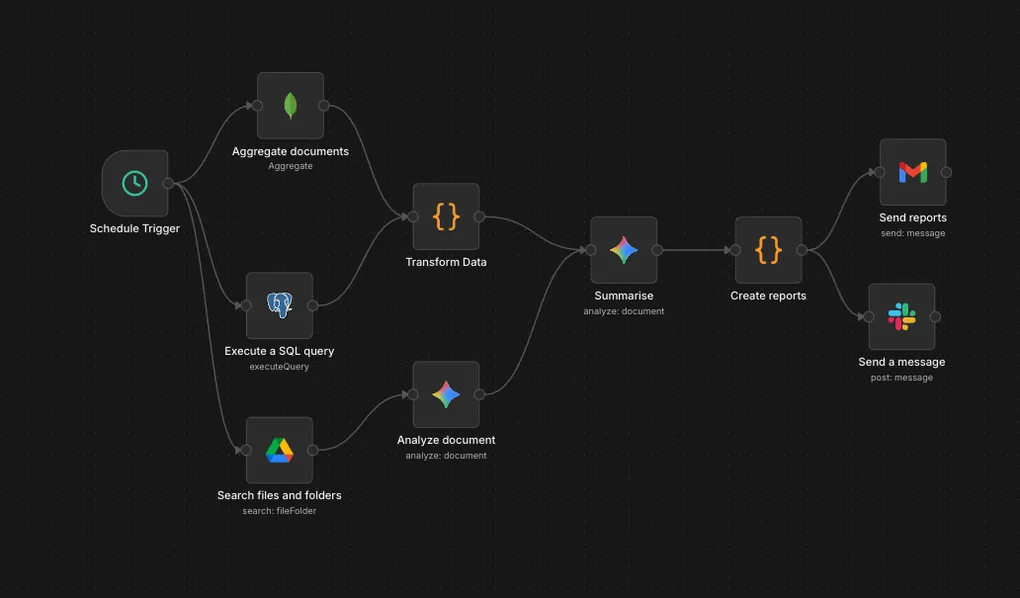
At Onyx Solutions, we practice what we preach. We use n8n to automate our internal processes, and one of our automations is our monthly reporting workflow.
Here’s how it works:
- Data collection: The workflow automatically gathers data from our time tracking system, project management system, and development systems
- Data processing: Information is validated, cleaned, and organized into meaningful metrics
- Report generation: PDF reports are generated automatically
- Email distribution: Reports are automatically sent to the relevant team members
What previously took hours of manual work each month now happens automatically.
The Time Savings Are Real
The most immediate benefit of automation is time. When you automate repetitive tasks, you’re not just saving minutes here and there. You’re often saving multiple work days per month.
Consider these common scenarios:
- Data entry and transfer between systems: 2-4 hours/week saved
- Report generation and distribution: 4-8 hours/month saved
- Invoice processing and follow-ups: 3-6 hours/week saved
- Lead qualification and routing: 5-10 hours/week saved
- Customer onboarding tasks: 2-3 hours per new customer saved
When you add up these savings across an organization, you’re looking at dozens or even hundreds of hours reclaimed each month. That’s time your team can spend on creative work, strategic thinking, and activities that actually require human judgment.
Adding AI to Your Automations
Here’s where things get really interesting. Modern automation platforms can integrate with AI services like OpenAI, Claude, and others. This opens up entirely new possibilities.
AI-Powered Data Analysis
Instead of just moving data from point A to point B, AI can actually analyze your data and surface insights you might have missed:
- Identify trends and patterns across large datasets
- Detect anomalies that warrant investigation
- Generate summaries of complex information
- Predict potential issues before they occur
Practical AI Integration Examples
Here are some ways businesses are combining automation with AI:
- Customer support: Automatically categorize and prioritize incoming tickets, draft initial responses
- Sales: Score leads based on behavior patterns, summarize call transcripts
- Marketing: Analyze campaign performance, generate content variations
- Finance: Detect unusual transactions, summarize financial reports
- HR: Screen resumes, draft job descriptions, analyze employee feedback
Automation Is for Every Business
Whether you’re a small startup or a large enterprise, automation can transform how you work. The tools are more accessible than ever, and the time investment to set up a workflow pays dividends immediately.
The question isn’t whether you should automate. It’s which processes to automate first.
Ready to automate your business processes? Contact us to discuss how we can help you save time and unlock new insights with intelligent automation.